
Traverse Consulting LLC
Supply chain planning and scheduling, from someone who has done it.
Process design, implementation, and training for advanced planning and scheduling systems, built on four decades of hands-on supply planning.
Get in touchSee the track recordAbout
Making complex planning simple
Mac Jacob spent 36 years at Procter & Gamble helping build one of the world’s top supply chains. As Group Director, Global Supply Network Operations, he held worldwide responsibility for P&G’s advanced planning and scheduling, distribution requirements planning, rough-cut capacity planning, and supply chain master data, and consistently led the company’s most complex new planning solutions from design through global rollout. He is a member of P&G’s Magnus Society, recognizing sustained contribution to Supply Network Operations.
Since founding Traverse Consulting in 2014, Mac has worked on supply chain redesign for large global manufacturers, mapped a leading planning software company’s data model to SAP, and developed the production scheduling software that is now Redzone Scheduling. He continues to help manufacturers implement Redzone Scheduling and get real value from it, both through Traverse and as a member of the Zinata Collective, a network of experienced manufacturing consultants delivering advanced scheduling implementations and supply chain improvement.
Clients know him for explaining planning systems in clear, practical terms to everyone from senior supply leaders to the planners who use the tools every day, and for building lasting capability by teaching others. When he isn’t working, Mac coaches with the Harbor Springs High School ski team.
Book
The book on process industry scheduling
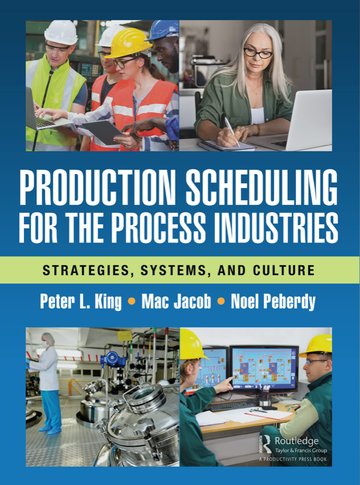
Production Scheduling for the Process Industries
Strategies, Systems, and Culture · Peter L. King, Mac Jacob, and Noel Peberdy · Productivity Press, 2023
A practical guide for manufacturing and planning leaders on how production scheduling drives stable operations, throughput, inventory, and customer service, and how poor scheduling strategies and systems quietly cause problems that get blamed on the plant floor.
It covers structured, repeating schedules such as product wheels, the trade-offs between throughput, inventory, and delivery, how scheduling software compares with spreadsheets and ERP scheduling modules, and a roadmap for implementation and leadership commitment.
Services
Where I can help
Planning process redesign
Re-engineering planning and scheduling processes so an advanced system can actually do its job, instead of planners working around it.
Scheduling system implementation
Business leadership for APS rollouts: configuration of rules and constraints, data readiness, standard work, and go-live support.
Documentation & training
User documentation, instructor-led training, and eLearning that build planner capability and cut classroom time.
Software selection & business case
Assessing whether an advanced planning system will pay out, and building the value case for it.
Inventory management
Inventory target setting and safety stock policy, taught inside P&G and to major suppliers.
SAP supply planning
Deep experience with SAP R/3, APO, and gATP production and distribution planning processes and data.
Track record
Selected implementations
OMP+ Advanced Planning & Scheduling
Built the team that implemented 35 P&G sites worldwide in under three years: process, procedures, documentation, training, qualification, and change management.
Aspen Tech SCM
Business leader for 25 global P&G sites, covering business processes, standard procedures, help files, education, and qualification.
Schedulex APS
Business leader and project manager for 12 P&G diaper and papermaking sites.
SAP Global Available-to-Promise
Supply planning leader for the SAP gATP implementation across P&G North America and Europe.
SAP APO Distribution Requirements Planning
Business leader for P&G’s global SAP APO DRP implementation.
SAP R/3 & MRP II, North America
Implemented MRP II and SAP R/3 production execution, warehouse management, and site planning at every P&G North American site.
Insights
Notes on advanced planning
Do you need an advanced planning and scheduling system?
Signs that an APS will pay out
Do you need an advanced planning and scheduling system?
Signs that an APS will pay outI’ve implemented linear-programming-based advanced planning and scheduling (APS) applications at more than 75 sites since 1989. An APS implementation is not to be taken lightly: it usually requires re-engineering the planning process and higher skill levels from planners. These are the strongest signs it will pay out:
- Tightly coupled make/pack or feeding/consuming operations.
- Scheduling difficulty beyond the scope of a single planner.
- Constrained production.
- Highly deployed inventory.
- Rescheduling required within the day.
- Production and shipping that must be coordinated within the day. Otherwise you may plan to ship at 10 am something that won’t be produced until 2 pm.
- Complex spreadsheets used to plan production or distribution.
You can’t plan the way you used to and expect improvement
Re-engineering the planning process for an APS
You can’t plan the way you used to and expect improvement
Re-engineering the planning process for an APSTo gain productivity and create better plans with an advanced planning and scheduling system, you must do three things: precisely schedule the minimum horizon, allow the system freedom to plan, and focus on the real constraints.
Schedule the minimum horizon
With less capable systems, planners spend time building a long-term plan for capacity projections and supplier planning. An APS can create that plan automatically from the rules and constraints you configure. Manually adjusting it adds no value, because it will change the next time you plan. If the longer horizon doesn’t look right, revisit the constraints and planning rules rather than adjusting the plan by hand.
Allow the system the freedom to plan
If everything is a constraint, no automated plan can satisfy them all. Planners end up adjusting the plan by hand to make it feasible, which means breaking constraints anyway, and then they conclude the system saves them nothing. Break the cycle by identifying the few constraints that truly cannot be violated, using weighted penalty costs for everything else, and letting the system find the low-cost plan.
Focus on the real constraints
If planners routinely violate something to get a feasible plan, it isn’t a real constraint.
Why scheduling gets hard so fast
What drives the value of advanced and concurrent planning
Why scheduling gets hard so fast
What drives the value of advanced and concurrent planningThe number of possible production sequences grows factorially with the number of products on a line: 4 products have 24 possible sequences, 8 have 40,320, and 15 have about 1.3 trillion. The planner’s job is to find the one that minimizes setup cost while protecting customer service. These factors determine how much an advanced planning system is worth:
- Planners per value stream. The ideal is one planner across the whole horizon; benchmark companies use no more than two.
- Capacity-to-demand ratio. Tight capacity leaves no room to run the wrong product.
- Levels of production. The best schedule at one level is rarely optimal, or even feasible, at another.
- Storage between levels. Less buffer time means more blocking and starvation.
- Shared operations and resources. Shared lines, crews, and washout stations need visibility and coordination.
- Planning cycle frequency. A shorter cycle cuts response time and safety stock, but without better tools it adds planner workload.
- Reaction time. The time to recognize the plan is off track, replan, produce, and ship drives the inventory you have to carry.
Cut instructor-led training time in half with eLearning
A lesson from a global OMP+ rollout
Cut instructor-led training time in half with eLearning
A lesson from a global OMP+ rolloutAt P&G we didn’t have enough qualified instructors to support a global OMP+ implementation. Our answer was a set of eLearning modules that let students learn the basics of the software at their own pace, and completing them was required before attending instructor-led sessions.
Instructor-led training time fell by 50%, and students retained more. Classroom time went to the difficult topics that need interaction, and the approach let us offer remote classes to anyone, anywhere in the world.
Contact
Let’s talk about your planning challenge
Whether you’re evaluating a scheduling system, mid-implementation, or trying to get more out of one you already have, I’m glad to compare notes.
macjacob@traverse-consulting.comHarbor Springs, Michigan